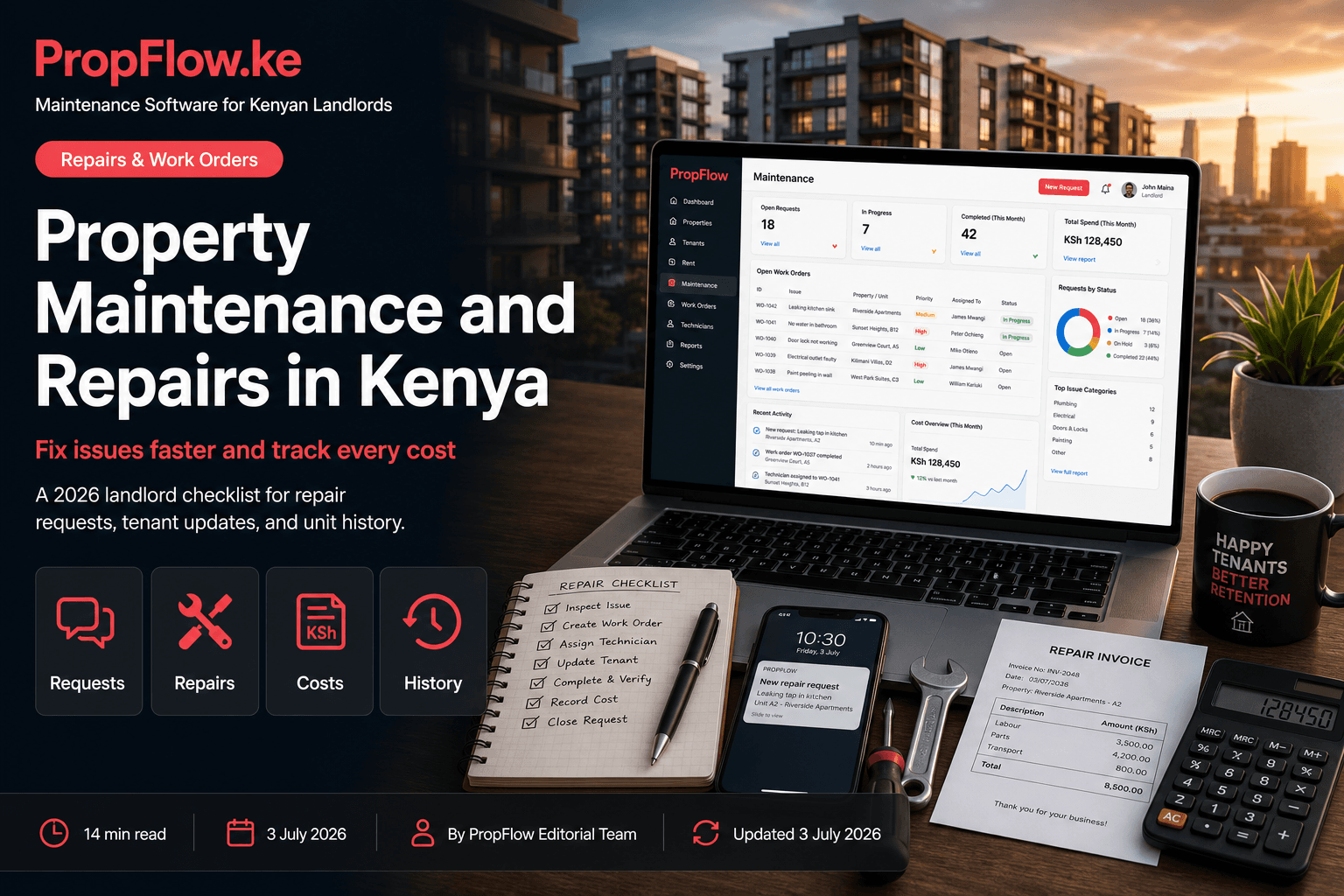
Property Maintenance and Repairs in Kenya: 2026 Landlord Checklist
A practical 2026 checklist for Kenyan landlords to manage property maintenance and repairs, tenant requests, work orders, repair costs, updates, and unit history.
Key Takeaways
- Why Property Maintenance Matters More Than Landlords Think
- The 2026 Property Maintenance and Repairs Checklist
- Step 1: Create One Official Repair Request Channel
- Step 2: Separate Emergency, Urgent, Routine, and Cosmetic Issues
Published: July 3, 2026 Updated: July 3, 2026 Reading Time: 14 minutes Keywords: property maintenance, property maintenance and repairs, property maintenance software Kenya, landlord repair checklist, rental property repairs Kenya
Property maintenance is one of the quietest profit leaks in rental management. Rent may be collected every month, but a leaking roof, blocked drainage, faulty wiring, damaged lock, or slow plumbing response can turn a good tenant into a vacancy risk very quickly.
For Kenyan landlords, property maintenance and repairs are not just operational tasks. They affect rent flow, tenant retention, property value, inspection records, owner confidence, and monthly expenses. A repair request that is not tracked properly can become a dispute, a repeated complaint, or an unexpected cost that no one can explain later.
This checklist gives landlords, property managers, and caretakers a practical way to handle maintenance from the first tenant report to the final cost record.
Quick answer: good property maintenance in Kenya needs a clear request channel, fast triage, written repair records, assigned responsibility, tenant updates, cost tracking, proof of completion, and unit-level history. If any of those steps live only in WhatsApp, memory, or a notebook, the landlord will eventually lose time, money, or trust.
If you want the software side of this workflow, see PropFlow's property maintenance and repairs page. If you are comparing full landlord systems, read the guide to property management software in Kenya.
Why Property Maintenance Matters More Than Landlords Think
Many landlords treat maintenance as something to handle only when a tenant complains. That approach works for one unit when the owner lives nearby. It breaks down as soon as you manage multiple units, use caretakers, or work with external fundis.
Maintenance affects five areas of rental performance.
1. Tenant Retention
Tenants do not only leave because rent is high. They also leave when small issues are ignored. Slow repairs tell a tenant that the landlord is not paying attention. Fast, clear updates create confidence, even when the issue takes time to solve.
A tenant can tolerate a delayed repair if they know:
- The issue was received
- Someone inspected it
- A repair person was assigned
- The landlord approved the work
- There is an expected completion date
Silence is what causes frustration.
Enjoying this article? Get more like it.
Free landlord tips + M-Pesa rent collection guides, every 2 weeks.
2. Rent Flow
Maintenance problems can become rent problems. A tenant with an unresolved issue may delay rent, ask for a discount, or use the complaint as a reason to avoid payment. Even when the landlord is legally entitled to collect rent, the operating relationship becomes harder.
Good maintenance records support rent collection because they show that the landlord responds to issues, communicates clearly, and keeps a history of what was done.
3. Property Value
Small repairs become expensive when they are ignored. A small leak can damage ceilings, walls, floors, cabinets, paint, and electrical fixtures. Poor drainage can damage compound surfaces. Loose tiles can become safety issues.
Preventive maintenance is usually cheaper than emergency maintenance.
4. Expense Control
Landlords lose money when repair costs are not recorded per unit. Without unit-level history, you cannot answer basic questions:
- Which unit has repeated plumbing problems?
- Which property has the highest repair cost?
- Which fundi is reliable?
- Which issue was caused by normal wear and tear?
- Which issue may have been caused by tenant negligence?
If every expense is only written as "repairs", the landlord cannot see patterns.
5. Dispute Prevention
Maintenance records protect both the landlord and the tenant. If a tenant says they reported an issue three weeks ago, the landlord should be able to see the request date, photos, assigned person, status, and follow-up notes.
This is not about blaming tenants. It is about keeping facts clear.
The 2026 Property Maintenance and Repairs Checklist
Use this checklist for every repair request, whether you manage 3 units or 300 units.
Step 1: Create One Official Repair Request Channel
The first problem with property maintenance is scattered reporting. A tenant may call the caretaker, message the landlord on WhatsApp, send a photo to the property manager, or tell a guard at the gate. By the time someone tries to fix the issue, nobody has the full story.
Create one official way for tenants to report repairs. It can be:
- A tenant portal
- A maintenance request form
- A dedicated WhatsApp number
- An SMS format
- A caretaker escalation process
- A property management system like PropFlow
The channel matters less than consistency. The goal is to prevent repair requests from disappearing into personal chats.
A good repair request should capture:
- Tenant name
- Property name
- Unit number
- Phone number
- Issue category
- Description
- Photos or video
- Date reported
- Urgency
- Whether the issue affects safety, water, electricity, access, or occupancy
If a request does not capture the property and unit, it is already incomplete.
Step 2: Separate Emergency, Urgent, Routine, and Cosmetic Issues
Not every repair has the same priority. A broken main door lock is not the same as a chipped tile. A burst pipe is not the same as a loose cabinet handle.
Use four simple priority levels.
| Priority | Examples | Recommended action |
|---|---|---|
| Emergency | Fire risk, electrical sparks, burst pipe, flooding, blocked main sewer, unsafe door lock | Act immediately and keep tenant updated |
| Urgent | No water, no power in unit, major leak, broken toilet, security issue | Same day or next day response |
| Routine | Leaking tap, loose hinge, broken socket cover, minor drainage issue | Schedule within a few days |
| Cosmetic | Paint touch-up, small cracks, worn finishes, non-urgent fixture replacement | Plan during inspection or vacancy |
This triage protects your time and budget. It also helps tenants understand why one issue is handled faster than another.
Step 3: Acknowledge Every Request
The first tenant update should be fast. It does not need to solve the issue immediately. It only needs to confirm that the request was received and that someone is handling it.
Example acknowledgement:
Hi Mary, we have received your maintenance request for the leaking kitchen sink in Unit B4. We are reviewing it and will update you on the next step.
This one message reduces follow-up calls and gives the tenant confidence that the issue is in motion.
Step 4: Inspect Before Approving Costly Work
Some repairs are obvious from photos. Others need inspection. Before approving expensive work, confirm the issue.
Inspection should answer:
- What exactly is broken?
- Is the issue inside the unit, common area, or external system?
- Is it urgent?
- What materials are needed?
- Is this a repeat problem?
- Could it affect another unit?
- Is there any evidence of misuse or neglect?
Do not rely only on verbal descriptions for costly repairs. Ask for photos, videos, or an inspection note.
Step 5: Create a Work Order
A work order is the difference between "I told someone to fix it" and "This repair is being managed."
Every work order should include:
- Work order number
- Property and unit
- Request description
- Priority
- Assigned person
- Expected start date
- Expected completion date
- Approved budget or estimate
- Materials required
- Status
- Notes
- Photos before and after
If you use a system like PropFlow, the work order becomes part of the unit history. If you use spreadsheets, create a consistent template and update it every time.
Step 6: Assign Responsibility Clearly
Maintenance fails when nobody owns the next step. The landlord thinks the caretaker is handling it. The caretaker thinks the fundi was called. The tenant thinks the landlord is ignoring them.
Every request needs one current owner.
Examples:
- Caretaker to inspect
- Electrician to quote
- Plumber to repair
- Property manager to approve cost
- Landlord to confirm budget
- Tenant to provide access
Write the current owner down. Do not keep it in memory.
Step 7: Communicate Access Requirements
Many repairs are delayed because the tenant is not available, the caretaker has no key, or the repair person arrives without notice.
Before sending someone to the unit, confirm:
- Tenant availability
- Preferred time window
- Whether the tenant must be present
- Whether the caretaker can provide access
- Contact number for the repair person
- Any safety or privacy expectations
For occupied units, access communication matters. It protects trust.
Step 8: Track Cost Before and After Completion
For every repair, separate estimate from actual cost.
Track:
- Labour estimate
- Materials estimate
- Transport estimate
- Approved amount
- Final labour cost
- Final materials cost
- Receipt or invoice
- Payment method
- Date paid
- Person paid
This helps with budgeting and reporting. It also helps identify unusual cost patterns.
Example:
| Item | Estimate | Actual |
|---|---|---|
| Labour | KES 2,500 | KES 2,500 |
| Materials | KES 3,000 | KES 3,450 |
| Transport | KES 500 | KES 500 |
| Total | KES 6,000 | KES 6,450 |
Without this structure, you only remember that "the repair was around six thousand".
Step 9: Verify Completion
Do not close a repair just because a fundi says it is done. Verify.
Verification can include:
- Tenant confirmation
- Caretaker inspection
- Photo after repair
- Video proof
- Receipt or invoice
- Test result, such as water running or power restored
For recurring issues, schedule a follow-up check. A plumbing repair may look fixed today and leak again tomorrow.
Step 10: Close the Loop With the Tenant
When the repair is completed, update the tenant.
Example:
Hi Mary, the kitchen sink repair has been completed today. Please confirm if everything is working well. If the leak continues, reply here and we will reopen the request.
This final message does three things:
- It confirms completion
- It invites feedback
- It creates a written record
Tenants notice when landlords close the loop.
Step 11: Save the Repair to Unit History
Every unit should have a maintenance history. This is where many landlords fail.
Unit history should show:
- All repair requests
- Dates reported
- Issue categories
- Repair costs
- Assigned workers
- Photos
- Notes
- Completion dates
- Repeat issues
This history becomes useful during:
- Tenant move-out
- Deposit discussions
- Property inspections
- Budget planning
- Renovation planning
- Sale or valuation discussions
If a unit has repeated plumbing repairs, you may need a deeper fix rather than another quick patch.
Recommended Response Time Targets
Response times do not have to be perfect, but they should be consistent.
| Issue type | First response | Inspection or action | Tenant update |
|---|---|---|---|
| Emergency | Immediately | Same day | Same day |
| Urgent | Within a few hours | Same day or next day | Same day |
| Routine | Within 24 hours | 2 to 5 days | When scheduled |
| Cosmetic | Within 2 days | Planned batch work | Before work starts |
The first response is often more important than the final fix. A tenant who receives updates is less likely to assume nothing is happening.
Common Property Maintenance Categories in Kenya
Most rental property repairs fall into predictable categories. Tagging each request by category makes reporting easier.
Plumbing
Common issues:
- Leaking taps
- Blocked drains
- Low water pressure
- Burst pipes
- Faulty toilets
- Leaking sinks
- Water tank or pump problems
What to track:
- Exact location
- Severity
- Water damage
- Repeat history
- Parts replaced
- Plumber used
- Cost
Plumbing issues should be handled quickly because water damage spreads.
Electrical
Common issues:
- Faulty sockets
- Tripping breakers
- Lighting failure
- Power loss in one room
- Exposed wires
- Burning smell
What to track:
- Safety risk
- Affected rooms
- Photos
- Electrician inspection
- Parts replaced
- Completion proof
Electrical issues should never be handled casually. Use qualified technicians.
Doors, Locks, and Security
Common issues:
- Broken locks
- Loose hinges
- Damaged doors
- Broken windows
- Gate issues
- Missing keys
What to track:
- Security impact
- Tenant access
- Whether replacement keys were issued
- Who received keys
- Photos before and after
Security-related repairs often need urgent treatment because they affect tenant safety.
Painting and Finishes
Common issues:
- Peeling paint
- Damp marks
- Cracks
- Broken tiles
- Damaged cabinets
- Worn fixtures
What to track:
- Whether issue is cosmetic or structural
- Room affected
- Cause
- Materials
- Labour cost
- Whether work should wait for vacancy
Not every cosmetic issue needs immediate repair, but every issue should be recorded.
Common Areas
Common issues:
- Staircase lighting
- Parking damage
- Drainage
- Compound cleanliness
- Gate motor
- Water tank area
- Shared corridors
What to track:
- Affected tenants
- Safety impact
- Shared cost if applicable
- Contractor assigned
- Completion date
Common-area maintenance affects multiple tenants, so delays create wider dissatisfaction.
Maintenance Budgeting: How Much Should Landlords Set Aside?
There is no single perfect maintenance budget for every property. Age, location, construction quality, tenant turnover, and property type all matter.
As a practical operating habit, landlords should set aside a maintenance reserve every month instead of waiting for repairs to surprise them.
You can start with one of these methods.
Method 1: Percentage of Monthly Rent
Set aside a percentage of collected rent for maintenance.
Example:
- Monthly rent collected: KES 300,000
- Maintenance reserve: 5 percent
- Monthly reserve: KES 15,000
This method is simple and works well for small landlords.
Method 2: Cost per Unit
Set a fixed amount per unit each month.
Example:
- 20 units
- KES 1,000 per unit maintenance reserve
- Monthly reserve: KES 20,000
This method is easy to understand, but it may understate costs for older properties.
Method 3: History-Based Budget
Use actual repair history from the past 12 months.
Example:
- Last 12 months maintenance cost: KES 480,000
- Monthly average: KES 40,000
- Add 10 percent buffer: KES 44,000
This is the best method once you have reliable maintenance records.
If your records are poor, start tracking from today. In 6 to 12 months, your budget will be much more accurate.
What to Record for Every Repair Cost
A repair cost record should be clear enough that you can understand it six months later.
Record:
- Property
- Unit
- Tenant
- Category
- Description
- Date reported
- Date repaired
- Vendor or fundi name
- Labour cost
- Materials cost
- Transport cost
- Total cost
- Receipt or invoice
- Payment method
- Notes
Do not write only "plumbing - KES 8,000". That is not enough detail for reporting.
Good record:
Unit A7, Riverside Apartments. Kitchen sink leak reported on July 3, 2026. Plumber replaced trap and seal. Labour KES 2,500, materials KES 1,850, transport KES 500. Total KES 4,850. Tenant confirmed repair completed.
That record is useful.
Tenant Communication Templates
Use consistent messages so tenants know what to expect.
Request Received
Hi [Tenant Name], we have received your maintenance request for [issue] in [unit]. We will review it and update you on the next step.
Inspection Scheduled
Hi [Tenant Name], [Name] will inspect the issue on [date] between [time]. Please confirm if you will be available or if the caretaker can provide access.
Work Approved
Hi [Tenant Name], the repair for [issue] has been approved. [Technician Name] is scheduled for [date/time]. We will update you after completion.
Delay Update
Hi [Tenant Name], the repair is delayed because [reason]. The new expected time is [date/time]. We will keep you updated.
Repair Completed
Hi [Tenant Name], the repair for [issue] has been completed. Please confirm if everything is working well.
Templates reduce stress because your team does not need to invent a message every time.
Spreadsheet vs Property Maintenance Software
Spreadsheets can work at the beginning. They are cheap, flexible, and familiar. But they become weak when maintenance volume grows.
| Need | Spreadsheet | Maintenance software |
|---|---|---|
| Tenant request capture | Manual | Structured |
| Photos | Hard to organize | Attached to request |
| Work order status | Manual update | Status workflow |
| Tenant updates | Separate channel | Connected to request |
| Unit history | Easy to miss | Automatic history |
| Cost reporting | Manual formulas | Dashboard reports |
| Team assignment | Not built in | Assigned ownership |
| Repeat issue tracking | Difficult | Searchable |
If you manage only a few units, a spreadsheet may be enough if you are disciplined. If you manage many units or rely on a caretaker, a dedicated system becomes more useful.
For a wider comparison, read Spreadsheets vs. Property Management Software in Kenya.
How PropFlow Helps With Property Maintenance and Repairs
PropFlow is built for Kenyan landlords who need rent, tenants, payments, maintenance, and reports in one place.
For maintenance, PropFlow helps you:
- Capture repair requests by property and unit
- Keep tenant details connected to each request
- Track status from reported to completed
- Assign work to the right person
- Record notes and cost
- Keep unit maintenance history
- Connect maintenance records with landlord reporting
- Reduce scattered WhatsApp follow-ups
The goal is not only to fix repairs. The goal is to make every repair traceable.
If you want the maintenance workflow, start here: property maintenance and repairs software. If you want the full landlord operating system, see property management software in Kenya.
A 30-Day Maintenance Cleanup Plan
If your maintenance process is messy today, do not try to fix everything at once. Use this 30-day cleanup.
Week 1: Standardize Reporting
Choose one official repair request channel. Tell tenants how to report issues. Ask caretakers and property managers to stop keeping maintenance requests only in personal chats.
Create a simple request format:
- Name
- Unit
- Issue
- Photo
- Urgency
Week 2: Build the Active Repair List
List every open maintenance issue.
For each issue, add:
- Property
- Unit
- Tenant
- Date reported
- Category
- Priority
- Current status
- Assigned person
- Next action
This gives you visibility.
Week 3: Add Cost Tracking
For every open and new repair, track estimate and actual cost. Keep receipts where possible. Separate labour from materials.
At the end of the week, review total maintenance cost by property.
Week 4: Create Unit History
Pick your highest-maintenance property first. Create a basic maintenance history per unit.
At minimum, record:
- Issue
- Date
- Cost
- Technician
- Status
- Notes
After one month, you will have a cleaner process and better reporting.
Maintenance Mistakes to Avoid
Avoid these common mistakes:
- Letting tenants report repairs through too many channels
- Failing to acknowledge requests
- Treating all issues as the same priority
- Approving work without photos or inspection
- Paying repair costs without recording details
- Closing repairs without tenant confirmation
- Ignoring repeated issues in the same unit
- Keeping all maintenance knowledge with one caretaker
- Waiting until move-out to discuss damage
- Not tracking repair cost by property
Most of these mistakes are not caused by bad intentions. They are caused by weak systems.
Property Maintenance FAQ
What is property maintenance?
Property maintenance is the process of keeping a rental property safe, usable, clean, and functional. It includes repairs, inspections, common-area upkeep, plumbing, electrical work, fixtures, painting, security items, and tenant repair requests.
What is the difference between maintenance and repairs?
Maintenance is ongoing care that prevents problems or keeps the property in good condition. Repairs fix something that is already broken. For example, servicing a water pump is maintenance. Replacing a failed pump part is a repair.
How should landlords handle tenant repair requests?
Landlords should capture the request in writing, confirm the property and unit, assign priority, acknowledge the tenant, inspect if needed, approve work, assign a repair person, record cost, verify completion, and save the request to unit history.
Should landlords use WhatsApp for property maintenance?
WhatsApp is useful for communication, but it is weak as the only maintenance system. Requests get buried, photos are hard to organize, and cost history is not structured. If you use WhatsApp, also record the request in a spreadsheet or property management system.
What is property maintenance software?
Property maintenance software helps landlords capture repair requests, assign work, track status, record costs, communicate updates, and keep maintenance history for each property and unit.
Is PropFlow only for repairs?
No. PropFlow handles property management workflows including rent collection, M-Pesa payments, tenants, maintenance, receipts, and reports. Maintenance is one part of the full landlord operating system.
Final Takeaway
Good property maintenance and repairs are not about fixing everything instantly. They are about creating a reliable process: capture the request, prioritize it, assign responsibility, update the tenant, record the cost, verify the work, and keep the unit history.
That process protects rent flow, tenant trust, and property value.
If your maintenance process is currently scattered across calls, WhatsApp, notebooks, and memory, start with one simple step today: create a single active repair list. Then build from there.
When you are ready to make the process easier, PropFlow gives you a cleaner way to manage property maintenance and repairs together with rent, tenants, M-Pesa payments, receipts, and reports.
Get Free Landlord Tips in Your Inbox
Join 500+ Kenyan property owners. Get M-Pesa collection tips, tenant management guides, and PropFlow updates every 2 weeks.
No spam. Unsubscribe anytime. We respect your inbox.
Related Articles
Keep reading

Property Maintenance Management Guide for Kenyan Landlords (2026)
A 2026 maintenance management guide for Kenyan landlords covering repair requests, response times, cost tracking, tenant updates, and unit history.

Best Property Management Software in Kenya for Landlords in 2026
A detailed 2026 guide to choosing property management software in Kenya, covering M-Pesa rent collection, tenant records, maintenance, reports, KRA-ready records, and PropFlow.

How Much Kenyan Landlords Actually Lose to Late Rent (and 5 Ways to Fix It)
The real KES cost of late rent in Kenya, with a 12-unit Nairobi example and 5 fixes that drop late-payment rates from 20% to under 4%.