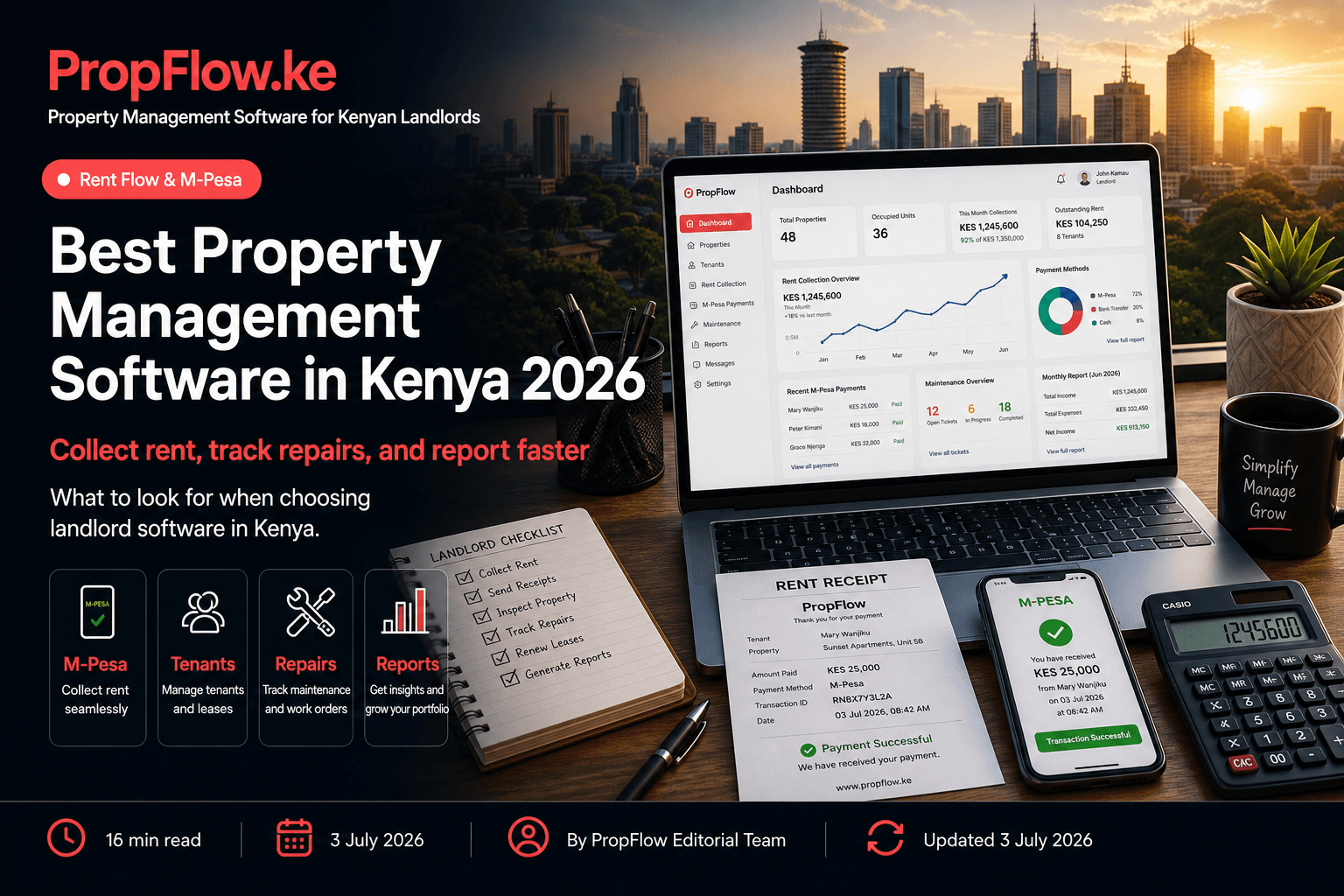
Best Property Management Software in Kenya for Landlords in 2026
A detailed 2026 guide to choosing property management software in Kenya, covering M-Pesa rent collection, tenant records, maintenance, reports, KRA-ready records, and PropFlow.
Key Takeaways
- What Counts as Property Management Software?
- What Makes Property Management Software "Best" in Kenya?
- The Kenyan Landlord Problems Software Must Solve
- The Best Property Management Software Features for Kenyan Landlords
Published: July 3, 2026 Updated: July 3, 2026 Reading Time: 16 minutes Keywords: property management software in Kenya, property management system in Kenya, property management apps for landlords, landlord software Kenya, M-Pesa rent collection
If you manage rental units in Kenya, the best property management software is not the one with the longest feature list. It is the one that helps you get rent paid on time, reconcile M-Pesa payments, keep tenant records clean, track maintenance without losing requests in WhatsApp, and produce reports you can actually use at month-end.
That is the practical definition of property management software in Kenya. It should solve the real problems Kenyan landlords face every month:
- Tenants paying through M-Pesa with inconsistent account references
- Caretakers confirming payments manually
- Rent reminders scattered across calls, SMS, and WhatsApp
- Receipts sent late or not sent at all
- Maintenance requests buried in chats
- Deposit balances and arrears tracked in spreadsheets
- KRA rental income records prepared under pressure
- Owners not knowing the true cash position until weeks after rent day
This guide breaks down what to look for, how to compare systems, what Kenyan landlords should avoid, and where PropFlow fits if you want a Kenya-first rental management system.
Quick answer: the best property management software for Kenyan landlords in 2026 should combine M-Pesa rent collection, tenant and unit records, automated reminders, digital receipts, maintenance tracking, owner reporting, and exportable rent records in one workflow.
What Counts as Property Management Software?
Property management software is a system that helps a landlord, property manager, caretaker, or real estate operator run rental units from one place.
At minimum, it should manage:
- Properties
- Units
- Tenants
- Rent invoices or monthly charges
- Payments
- Receipts
- Arrears
- Deposits
- Maintenance requests
- Notices and communication
- Reports
In Kenya, the meaning is narrower and more specific. A system that cannot handle M-Pesa properly is not enough for most landlords. A system that treats rent like a generic invoice is also not enough. Rental property has recurring charges, tenant balances, unit history, partial payments, deposits, repairs, move-ins, move-outs, and monthly reporting cycles.
That is why Kenyan landlords usually outgrow ordinary tools in this order:
- Notebook or paper receipt book
- Excel or Google Sheets
- WhatsApp groups and M-Pesa screenshots
- Generic accounting software
- Property management software built for rentals
The move from stage 4 to stage 5 matters. Accounting software can record money after it arrives. Property management software helps the rent arrive in the first place.
What Makes Property Management Software "Best" in Kenya?
"Best" depends on the landlord. A landlord with 3 units does not need the same system as a property manager handling 500 units for multiple owners. But the strongest systems share the same operating principles.
The best property management system in Kenya should be:
| Requirement | Why it matters in Kenya |
|---|---|
| M-Pesa-ready | Most tenants prefer mobile money, and manual reconciliation is where errors happen. |
| Tenant-first | Tenants need clear balances, receipts, payment instructions, and maintenance updates. |
| Unit-based | Rent belongs to a unit and lease, not just a customer record. |
| Maintenance-aware | Repairs affect tenant satisfaction, retention, and property value. |
| Report-friendly | Landlords need arrears, collections, expenses, deposits, and monthly summaries. |
| Mobile-friendly | Owners, caretakers, and tenants often operate from phones. |
| Kenya-compliant by design | Local tax, currency, payment, and recordkeeping realities should not be afterthoughts. |
| Easy to migrate into | If setup takes months, most landlords never finish. |
The best software is the one that reduces daily follow-up. If you still need to ask your caretaker, "Who has paid?" every week, the system is not doing enough.
Enjoying this article? Get more like it.
Free landlord tips + M-Pesa rent collection guides, every 2 weeks.
The Kenyan Landlord Problems Software Must Solve
1. Late Rent and Weak Follow-Up
Late rent is rarely one big failure. It is usually a chain of small delays:
- The tenant forgets the due date.
- The landlord waits two days before reminding them.
- The tenant asks for the amount again.
- The landlord checks a spreadsheet.
- The tenant pays partially.
- The receipt is delayed.
- The balance is not updated.
- Follow-up restarts the next week.
Good property management software breaks that chain. It should know the due date, generate the expected charge, remind the tenant, receive or record the payment, update the balance, and show arrears without a manual spreadsheet edit.
2. M-Pesa Reconciliation
M-Pesa is convenient for tenants, but messy for landlords when the workflow is not controlled.
Common reconciliation problems include:
- Tenants using the wrong account number
- A tenant paying for another unit
- Partial payments with no note
- Multiple tenants using one phone number
- Caretakers forwarding screenshots instead of confirmed records
- Owners manually searching M-Pesa messages
- Payments received after the monthly spreadsheet was already updated
A proper property management app should reduce the matching problem. Ideally, each payment should connect to the right tenant, unit, and invoice or monthly charge.
For landlords using STK Push or payment links, the system should pre-fill the amount and reference so the payment arrives with cleaner context. For landlords recording manual M-Pesa payments, the system should still create a clear audit trail.
3. Receipts and Proof of Payment
Receipts are not just politeness. They reduce disputes.
A good system should show:
- Who paid
- Which unit the payment belongs to
- Amount paid
- Payment date
- Payment method
- Reference code
- Balance before and after payment
- Receipt number or transaction reference
If a tenant says, "I paid last month," the answer should not depend on scrolling through messages. It should be searchable.
4. Maintenance Requests
Maintenance is one of the biggest reasons tenants become unhappy.
Without a system, the process usually looks like this:
- Tenant sends a WhatsApp message.
- Caretaker sees it but gets busy.
- Landlord asks for a photo.
- Tenant resends photo.
- Fundi is called.
- Cost is agreed verbally.
- Repair is done.
- No one records what happened.
- The same issue returns after two months.
Software should turn this into a ticket:
- Tenant
- Unit
- Issue type
- Description
- Photos
- Priority
- Assigned person
- Status
- Cost
- Completion notes
- History
That history matters. If Unit B4 has had three plumbing issues in six months, the problem may not be the tenant. It may be the pipework.
5. Owner Reporting
Landlords need more than "rent has come in." They need to know:
- Expected rent
- Collected rent
- Outstanding arrears
- Partial payments
- Vacant units
- Expenses
- Net cashflow
- Maintenance spend
- Deposit liability
- Tenant turnover
- Unit performance
If you manage property for other owners, reporting becomes even more important. Owners want transparency. They do not want to chase you for statements, and you do not want to rebuild reports from spreadsheets every month.
6. KRA-Ready Rental Records
A property management system should not replace tax advice, but it should keep better records.
KRA's current rental income tax guidance describes Monthly Rental Income as applying to qualifying resident persons earning residential rental income in Kenya, with a current MRI rate of 7.5% on gross rent received for qualifying rental income. KRA has also rolled out eRITS for property details, rental tax filing, and payment support.
That means landlords should keep clean monthly records:
- Gross rent expected
- Gross rent received
- Dates received
- Tenant and unit details
- Receipts
- Credits and withholding certificates where applicable
- Vacancies and nil months
- Expense records for landlords outside the MRI regime or where annual reporting applies
The software does not need to file the return for you. But it should make the numbers easy to verify before filing.
KRA Rental Income Tax guidance
The Best Property Management Software Features for Kenyan Landlords
1. Property and Unit Management
The system should let you create each property and every unit under it.
For each property, you should be able to store:
- Property name
- Location
- Owner
- Caretaker or manager
- Payment instructions
- Utility rules
- Service charge rules
- Notes
For each unit, you should track:
- Unit number
- Rent amount
- Deposit amount
- Occupancy status
- Current tenant
- Lease start date
- Lease end date
- Meter details if needed
- Unit-specific notes
This sounds basic, but many landlords skip it. They only track tenants. That becomes a problem when a tenant moves out. You lose the unit history.
Good software treats the unit as the permanent record and the tenant as the current occupant.
2. Tenant Records
Tenant records should be more than a name and phone number.
A useful tenant profile includes:
- Full name
- Phone number
- Email where available
- ID or KRA PIN where collected lawfully and necessary
- Emergency contact
- Unit
- Lease terms
- Deposit paid
- Rent amount
- Move-in date
- Payment history
- Maintenance history
- Notices sent
- Documents
Be careful with personal data. Collect only what you need, secure it, and make sure access is limited to people who genuinely need it.
3. Rent Schedules and Monthly Charges
A serious property management system should generate monthly rent charges automatically.
It should support:
- Fixed rent
- Service charge
- Parking charge
- Garbage charge
- Water charge
- Penalties where legally and contractually allowed
- One-off charges
- Partial payments
- Waivers or adjustments
- Credit balances
The most important part is consistency. If rent is due on the 5th, the system should not depend on you remembering to create an invoice.
4. M-Pesa Payment Collection
For Kenya, this is one of the biggest differentiators.
Look for:
- STK Push support
- Payment links
- Paybill or Till workflows
- Unit-level account references
- Automatic or assisted reconciliation
- Payment confirmation
- Failed payment handling
- Receipt generation
- Exportable payment records
A good M-Pesa workflow should answer three questions instantly:
- Who paid?
- Which unit did they pay for?
- What balance remains?
If the system cannot answer those three questions without manual searching, it is not solving the main rent collection problem.
5. Automated Reminders
Automated reminders protect cashflow.
A useful reminder system should support:
- Before-due reminders
- Due-day reminders
- Overdue reminders
- Partial-payment balance reminders
- Receipt confirmation
- Maintenance updates
- Lease renewal reminders
The tone matters. A good reminder is clear, professional, and consistent. It should not sound like harassment, but it should also not be vague.
Example reminder:
Hello Jane, your July rent for Unit B4 is KES 25,000 and is due on 5 July 2026. You can pay via M-Pesa using the payment link or account reference below. Thank you.
That is better than:
Rent?
6. Digital Receipts
Digital receipts should be automatic or very fast to issue.
They should include:
- Receipt number
- Tenant name
- Unit
- Amount
- Date
- Payment method
- Transaction reference
- Balance if any
- Landlord or property name
Tenants should not have to ask for receipts repeatedly. The system should make proof of payment part of the process.
7. Maintenance Management
Maintenance tools should be simple enough that a tenant or caretaker can use them without training.
A good workflow:
- Tenant reports issue.
- Landlord or manager reviews it.
- Issue is assigned to caretaker, fundi, or internal team.
- Cost estimate is recorded.
- Work is marked in progress.
- Completion photo or note is added.
- Cost is added to the property expense record.
- Tenant is updated.
The goal is not bureaucracy. The goal is memory. Properties become expensive when no one remembers what was fixed, who fixed it, and how much it cost.
Read more: Property Maintenance and Repairs for Kenyan Landlords
8. Financial Reports
At month-end, the system should produce reports without rebuilding them from scratch.
The most useful reports are:
- Rent roll
- Collections report
- Arrears report
- Tenant statement
- Unit statement
- Property income summary
- Expense report
- Maintenance cost report
- Owner statement
- Deposit register
- Export for accountant
Reports should be readable by normal landlords, not only accountants. A landlord should be able to open a dashboard and know whether the property is improving or leaking money.
9. Role-Based Access
Not everyone should see everything.
A good system should support different roles:
- Owner
- Property manager
- Caretaker
- Accountant
- Tenant
- Admin
For example, a caretaker may need to see maintenance tickets and tenant contacts but not full owner financial summaries. An accountant may need reports but not tenant WhatsApp messages. A tenant should only see their own unit and payments.
10. Mobile Experience
Many landlords operate from phones. Tenants definitely do.
The software should work well on mobile for:
- Checking balances
- Sending reminders
- Viewing payments
- Recording maintenance
- Uploading photos
- Downloading receipts
- Contacting support
If the mobile experience is poor, the system will be abandoned and everyone will go back to WhatsApp.
Comparing Options: Spreadsheet, Agent, Generic App, or PropFlow?
Here is a practical comparison for Kenyan landlords.
| Option | Best for | Strength | Weakness |
|---|---|---|---|
| Excel or Google Sheets | 1 to 3 units | Cheap and familiar | Manual reminders, manual M-Pesa matching, weak history |
| Caretaker-led management | Small buildings with trusted onsite help | Local presence | Owner visibility is weak unless records are digital |
| Traditional property agent | Hands-off landlords | Human follow-up and inspections | Fees, reporting delays, owner dependence on agent process |
| Generic accounting software | Businesses already running formal accounts | Good accounting structure | Not built for tenants, units, rent cycles, arrears, or maintenance |
| International property software | Larger teams with complex needs | Mature feature sets | Often not Kenya-first; M-Pesa, KES, WhatsApp, and local workflows may be weak |
| PropFlow | Kenyan landlords and property managers who want local rent operations | M-Pesa-aware, landlord-focused, tenant records, maintenance, reporting | Requires setup discipline in the first week |
The right answer may combine people and software. A caretaker can still inspect units. A property manager can still negotiate with tenants. The software should make their work visible, measurable, and easier to audit.
When Should a Kenyan Landlord Move From Excel to Software?
You should seriously consider property management software when any of these are true:
- You manage more than 5 units.
- Rent payments arrive through multiple phone numbers.
- You spend more than 2 hours per month reconciling payments.
- Tenants regularly ask for balances or receipts.
- You do not know arrears without checking a spreadsheet.
- Maintenance requests are handled through WhatsApp only.
- You manage property for another owner.
- You are planning to add more units.
- You want cleaner records for KRA, accountant, bank, or investor review.
Excel is not bad. Excel is just not a property operations system. It does not remind tenants, receive payments, create receipts, or manage repairs.
Read more: Spreadsheets vs. Property Management Software in Kenya
What a Good Dashboard Should Show
When you log in, the dashboard should answer the questions you ask every month:
- How much rent was expected?
- How much has been collected?
- Who has not paid?
- Which payments need reconciliation?
- Which units are vacant?
- Which maintenance issues are open?
- What expenses have been recorded?
- What is the net position for this property?
A good dashboard is not decoration. It is a control panel.
For a 20-unit building, a useful dashboard might show:
| Metric | Example |
|---|---|
| Expected monthly rent | KES 500,000 |
| Collected so far | KES 430,000 |
| Outstanding arrears | KES 70,000 |
| Paid tenants | 17 |
| Partially paid tenants | 1 |
| Unpaid tenants | 2 |
| Open maintenance tickets | 4 |
| Vacant units | 1 |
That view changes how you manage. Instead of asking, "Who has paid?" you ask, "What action is needed today?"
The M-Pesa Question: What Should You Ask Vendors?
Before choosing any property management app, ask these questions:
- Does it support M-Pesa workflows?
- Does it support STK Push or payment links?
- Can payments be tied to a specific tenant and unit?
- What happens when a tenant pays the wrong amount?
- What happens when a tenant pays with another person's phone?
- Can the system issue a receipt?
- Can I export payment reports?
- Can I see failed or pending payments?
- Can the tenant see their balance?
- Does the system support Kenyan shilling reports?
If the vendor cannot answer these clearly, be careful.
Read more: M-Pesa Rent Collection for Kenyan Landlords
The Maintenance Question: What Should You Ask Vendors?
Maintenance is where many systems are too shallow.
Ask:
- Can tenants submit repair requests?
- Can photos be attached?
- Can requests be assigned?
- Can I track status?
- Can I record repair costs?
- Can I see maintenance history per unit?
- Can I separate urgent repairs from routine work?
- Can caretakers access only what they need?
- Can I report monthly maintenance spend?
- Can I export the history?
If maintenance is only a notes field, it will not be enough for a growing portfolio.
Read more: Property Maintenance Management Guide for Kenyan Landlords
The Reporting Question: What Should You Ask Vendors?
Reports should not be an afterthought. They are how you prove what happened.
Ask:
- Can I download rent collection reports?
- Can I download tenant statements?
- Can I see arrears by tenant and unit?
- Can I separate rent, deposit, service charge, and penalties?
- Can I record expenses?
- Can I generate owner statements?
- Can I export to Excel or PDF?
- Can my accountant use the reports?
- Can I filter by property and date range?
- Can I keep records after a tenant moves out?
The best system is not just convenient during rent collection. It is also useful six months later when someone asks, "What happened in January?"
Read more: Property Financial Reporting Guide for Kenyan Landlords
Pricing: How Much Should Property Management Software Cost?
The right way to evaluate price is not subscription cost alone. Evaluate the cost of not having the system.
For example, a landlord with 15 units at KES 25,000 per unit has expected rent of KES 375,000 per month. If weak follow-up delays only 10% of that rent by 10 days, the cashflow pressure is real. If one unreconciled payment causes a tenant dispute, your time is lost. If one maintenance issue escalates because no one tracked it, the repair cost can be higher than a software subscription.
When comparing price, look at:
- Number of units included
- Payment collection features
- M-Pesa integration availability
- SMS or WhatsApp costs
- Number of users
- Tenant portal access
- Reporting exports
- Support
- Setup or onboarding cost
- Contract terms
Cheap software is expensive if no one uses it. Expensive software is also wasteful if it is built for a different market and needs workarounds for Kenyan rent collection.
How to Migrate From Spreadsheets to Property Management Software
Migration does not need to be complicated. Do it in phases.
Phase 1: Clean Your Unit List
Create a clean list with:
- Property name
- Unit number
- Current tenant
- Monthly rent
- Deposit held
- Phone number
- Lease start date
- Current balance
Do not import a messy spreadsheet. Clean it first.
Phase 2: Confirm Opening Balances
Before switching systems, confirm:
- Who is fully paid up
- Who is in arrears
- Who has credit
- Deposit balances
- Pending maintenance costs
Send statements to tenants if needed. It is better to resolve old confusion before starting a new system.
Phase 3: Set Up Payment Instructions
Make sure tenants know exactly how to pay.
Your instructions should include:
- Payment method
- Account reference
- Rent amount
- Due date
- What to do after payment
- Support contact
If using payment links or STK Push, test before announcing the change.
Phase 4: Run One Month in Parallel
For the first month, keep your old spreadsheet as backup while the system runs.
Compare:
- Expected rent
- Payments received
- Receipts issued
- Arrears
- Maintenance tickets
After one clean month, the new system becomes the source of truth.
Phase 5: Stop Manual Duplication
The biggest mistake is running software and spreadsheets forever. That creates double work and conflicting records.
Once the system is accurate, use exports for backup instead of maintaining a separate manual version.
A 7-Day Setup Plan
Use this simple setup plan if you want to move fast.
| Day | Task |
|---|---|
| Day 1 | List properties and units. |
| Day 2 | Add tenant names, phone numbers, rent amounts, and deposits. |
| Day 3 | Confirm opening balances and arrears. |
| Day 4 | Configure payment instructions and reminders. |
| Day 5 | Add caretaker or accountant access if needed. |
| Day 6 | Test one payment and one receipt. |
| Day 7 | Inform tenants and start the next rent cycle in the system. |
The goal is not perfection. The goal is a clean enough operating system before rent day.
What Small Landlords Need
If you have 1 to 5 units, you need simplicity.
Prioritize:
- Tenant list
- Rent reminders
- Payment records
- Digital receipts
- Simple arrears report
- Basic maintenance notes
Avoid overpaying for enterprise workflows. You do not need complex approval chains if you manage one apartment block yourself.
What Growing Landlords Need
If you have 6 to 30 units, you need control.
Prioritize:
- Automated monthly charges
- M-Pesa reconciliation
- Tenant statements
- Arrears aging
- Maintenance tickets
- Property-level reports
- Mobile access
This is the stage where spreadsheets start costing real money. You may still manage personally, but you need a stronger system.
What Property Managers Need
If you manage units for other owners, you need transparency.
Prioritize:
- Multi-property reporting
- Owner statements
- Role-based access
- Expense tracking
- Maintenance approvals
- Audit trail
- Exportable reports
- Communication records
Property managers are judged by trust. Clean records create trust.
Where PropFlow Fits
PropFlow is built for Kenyan landlords and property managers who want one system for rent collection, tenant records, maintenance, and reporting.
PropFlow is a strong fit if you want:
- Property and unit records
- Tenant profiles
- M-Pesa-aware rent collection workflows
- Rent reminders
- Digital receipts
- Arrears tracking
- Maintenance management
- Financial summaries
- Kenya-focused landlord workflows
- A system built around how Kenyan tenants actually pay and communicate
It is especially useful if you are moving from spreadsheets and want to stop managing rent through scattered WhatsApp messages, screenshots, and manual records.
Learn more: Property Management Software in Kenya
What PropFlow Should Not Replace
Good software does not remove the need for judgment.
You still need:
- Clear lease agreements
- Proper tenant screening
- Legal advice when handling disputes or evictions
- Tax advice where your situation is complex
- Physical inspection of units
- Good contractors and caretakers
- Human communication for sensitive matters
Software gives you records, workflow, reminders, and visibility. It does not replace good landlord decisions.
Red Flags When Choosing Property Management Software
Avoid systems that:
- Do not understand M-Pesa
- Cannot track units properly
- Treat rent as one-off invoices only
- Have no tenant balance history
- Have no maintenance workflow
- Cannot export reports
- Hide pricing until after a long sales process
- Require too many manual workarounds
- Have poor mobile usability
- Offer no support during setup
The biggest red flag is a system that looks impressive in a demo but does not match your monthly rent cycle.
Buying Checklist
Before choosing software, answer these questions:
| Question | Why it matters |
|---|---|
| How many units do I manage now? | Determines complexity and pricing. |
| How many units will I manage in 12 months? | Avoid switching twice. |
| How do tenants pay today? | Determines payment workflow. |
| Who follows up on arrears? | Determines user roles and reminders. |
| Who handles maintenance? | Determines ticket workflow. |
| Do I manage for other owners? | Determines reporting needs. |
| Do tenants need a portal? | Determines tenant experience. |
| Do I need accountant exports? | Determines reporting depth. |
| What records do I need for KRA? | Determines monthly reporting discipline. |
| Can I set it up before the next rent cycle? | Determines implementation success. |
FAQ: Property Management Software in Kenya
What is the best property management software in Kenya?
The best property management software in Kenya is the one that handles your actual rental workflow: properties, units, tenants, M-Pesa payments, rent reminders, receipts, arrears, maintenance, and reports. For landlords who want a Kenya-first system, PropFlow is built around local rent collection and landlord operations.
Do small landlords need property management software?
If you have 1 to 3 units and tenants always pay on time, a spreadsheet may be enough. Once you manage more units, start dealing with arrears, or need reliable receipts and maintenance history, software becomes useful quickly.
Is free rental property management software enough?
Free tools can help you start, but they usually cost you in manual work. If a free tool cannot send reminders, reconcile payments, issue receipts, or show arrears clearly, it may not be free in practice.
Should property management software support M-Pesa?
For most Kenyan landlords, yes. M-Pesa is central to rent collection. A system that does not support M-Pesa workflows will often push you back into screenshots, manual matching, and spreadsheet updates.
Can property management software help with KRA rental income records?
Yes, but it should not be treated as tax advice. Software can help you keep rent received, tenant, unit, receipt, and monthly summary records clean. For filing obligations, always confirm the current requirements with KRA or a qualified tax advisor.
What is the difference between property management software and accounting software?
Accounting software records financial transactions. Property management software runs rental operations: tenants, units, rent cycles, arrears, maintenance, receipts, and owner reporting. A landlord may need both as the portfolio grows.
Can tenants use property management apps?
They should be able to. A tenant-friendly system lets tenants see balances, receive reminders, pay rent, download receipts, and submit maintenance requests without calling the landlord every time.
How long does it take to set up property management software?
For a small or mid-sized portfolio, the first version can be set up in a few days if your unit list and tenant balances are clean. The hardest part is usually cleaning old records, not using the software.
Final Recommendation
If you are choosing property management software in Kenya in 2026, do not start with the prettiest dashboard. Start with your monthly pain.
Ask:
- Does rent come in on time?
- Do I know who has paid today?
- Can I prove every receipt?
- Can tenants get clear balances?
- Can I track repairs by unit?
- Can I produce reports without rebuilding spreadsheets?
- Can I prepare cleaner rental records when filing or reviewing tax obligations?
If the answer is no, it is time to move beyond spreadsheets.
PropFlow is built for that move. It gives Kenyan landlords a practical system for rent collection, M-Pesa workflows, tenant management, maintenance, and reporting.
Start your free PropFlow trial and run your next rent cycle with cleaner records, fewer follow-ups, and better visibility.
Get Free Landlord Tips in Your Inbox
Join 500+ Kenyan property owners. Get M-Pesa collection tips, tenant management guides, and PropFlow updates every 2 weeks.
No spam. Unsubscribe anytime. We respect your inbox.
Related Articles
Keep reading
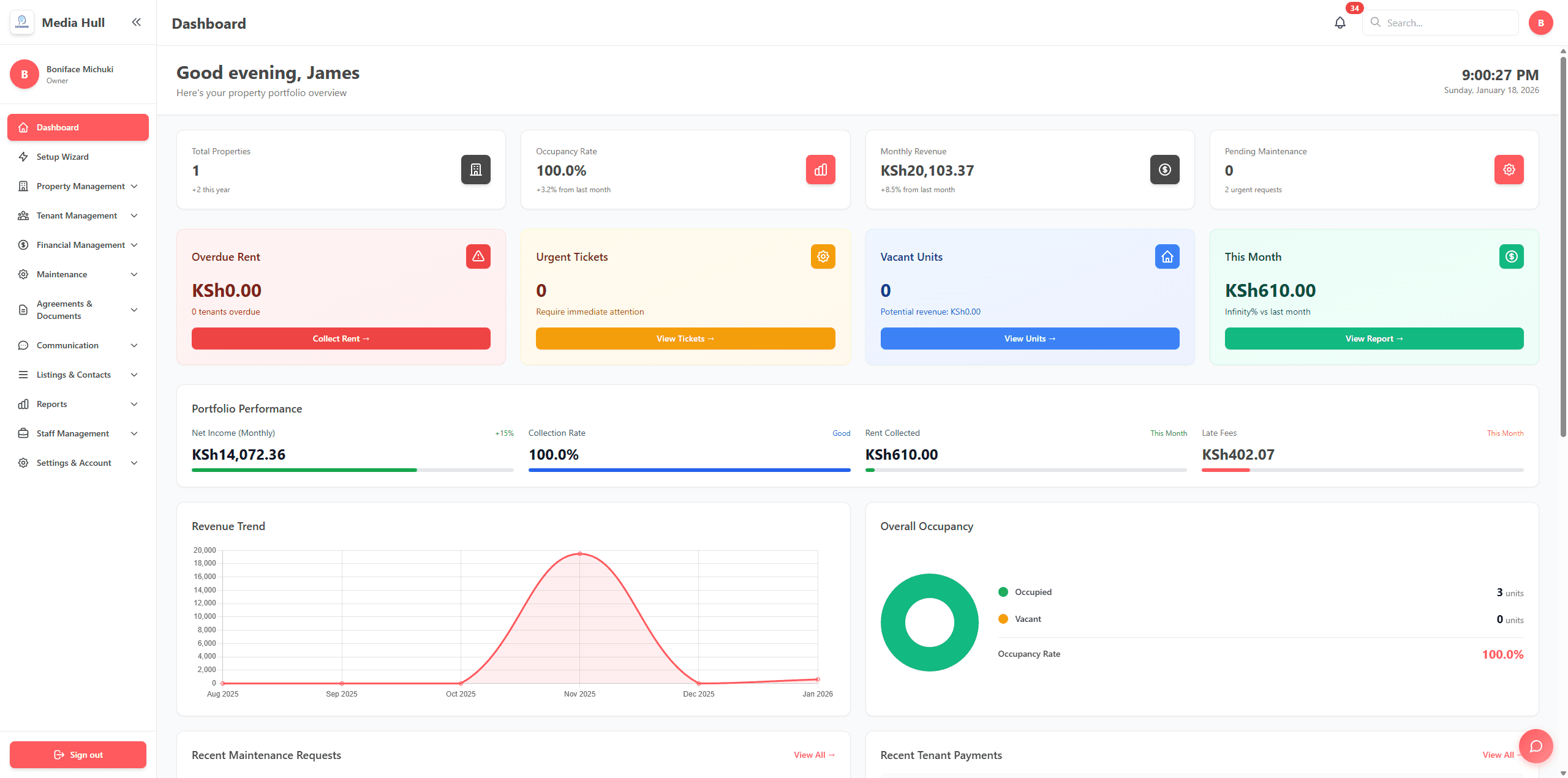
Spreadsheets vs. Property Management Software in Kenya: A KES Cost Breakdown (2026)
A shilling-denominated comparison of running rentals on Excel vs. a proper property management system. Includes a 10-unit case study.
Automated Property Management in Kenya: 2026 Landlord Guide
A 2026 guide for Kenyan landlords replacing spreadsheets with property management software, M-Pesa rent collection, maintenance tracking, and reporting.
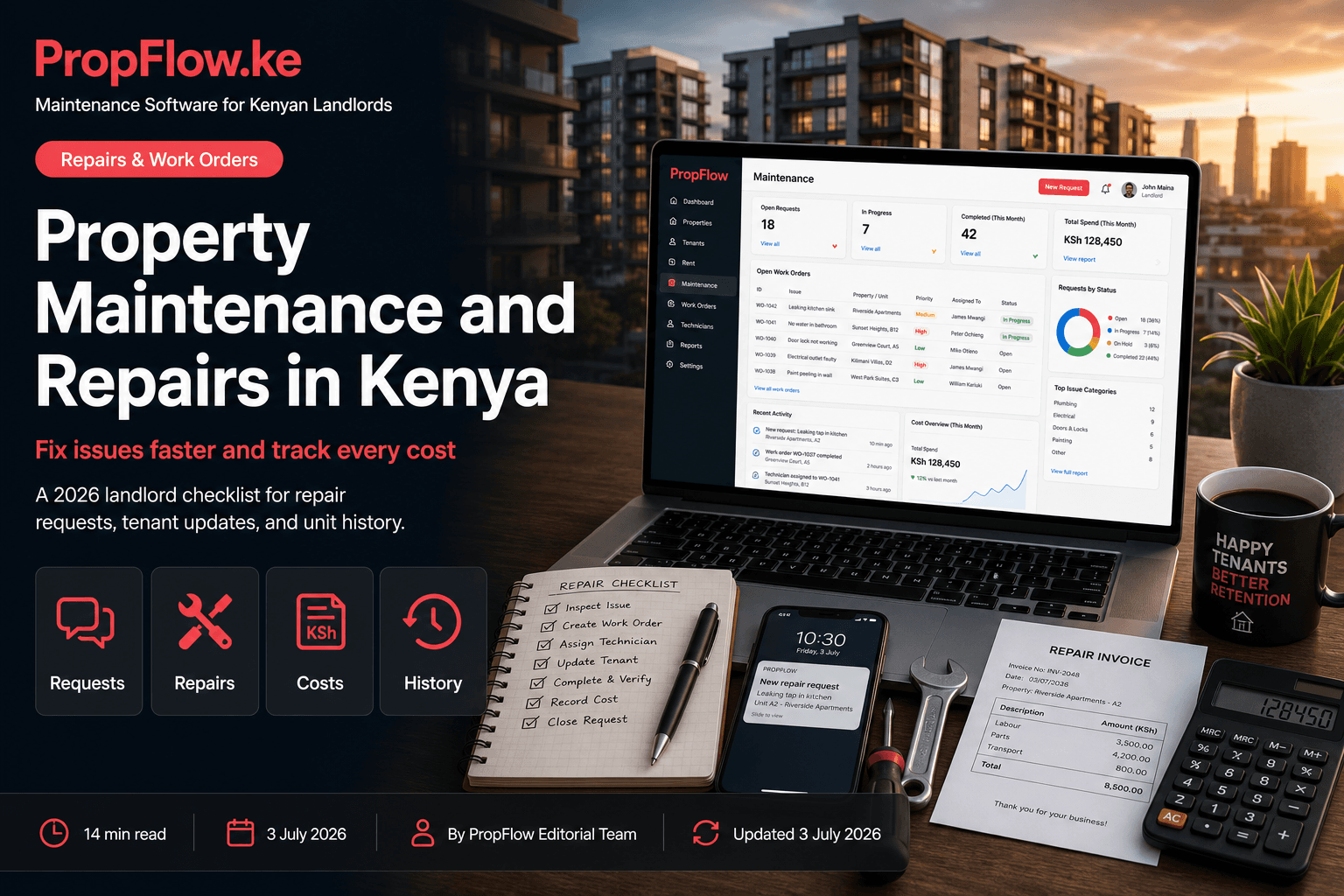
Property Maintenance and Repairs in Kenya: 2026 Landlord Checklist
A practical 2026 checklist for Kenyan landlords to manage property maintenance and repairs, tenant requests, work orders, repair costs, updates, and unit history.