
Rental Income Tax in Kenya: Complete KRA Guide for Landlords (2026)
Everything you need to know about filing rental income tax with KRA, including MRI tax, iTax, deductions, and penalties.
Key Takeaways
- Introduction: The Tax Reality Every Kenyan Landlord Must Face
- Understanding Rental Income Tax in Kenya
- How to File Rental Income Tax on iTax (Step-by-Step)
- Deductible Expenses (For Standard Tax Filers)
Published: March 16, 2026 Reading Time: 8 minutes Keywords: rental income tax Kenya, KRA landlord tax, rental tax filing, iTax rental income, property tax deductions Kenya
Introduction: The Tax Reality Every Kenyan Landlord Must Face
You bought your first rental property. Tenants moved in. M-Pesa payments started flowing. Life was good.
Then tax season arrived, and suddenly you're asking:
- "How much tax do I owe on my rental income?"
- "Do I file separately from my employment income?"
- "What expenses can I deduct?"
- "What happens if I haven't been filing?"
If these questions keep you up at night, you're not alone. Over 60% of Kenyan landlords either under-report or completely ignore their rental income tax obligations. The consequences? Penalties of up to 25% of unpaid tax, plus monthly interest.
This guide breaks down everything you need to know about rental income tax in Kenya for 2026, from the simplified MRI tax to filing on iTax, so you stay compliant and keep more of your hard-earned rental income.
Understanding Rental Income Tax in Kenya
Enjoying this article? Get more like it.
Free landlord tips + M-Pesa rent collection guides, every 2 weeks.
The Two Tax Options for Landlords
Kenya offers landlords two ways to pay tax on rental income. The option that applies to you depends on your total annual rental income.
Option 1: Monthly Rental Income (MRI) Tax - The Simplified Route
- Applies to: Landlords earning between KES 288,000 and KES 15,000,000 per year from rent
- Tax rate: 7.5% of gross rental income
- Filing: Monthly, by the 20th of the following month
- No deductions allowed (but the rate is already low)
Example:
- Monthly rent collected: KES 150,000
- MRI tax due: KES 150,000 x 7.5% = KES 11,250 per month
- Annual tax: KES 135,000
Option 2: Standard Income Tax
- Applies to: Landlords earning above KES 15,000,000 per year, or those who opt out of MRI
- Tax rate: Progressive rates from 10% to 35%
- Filing: Annual returns plus instalment tax
- Deductions allowed (mortgage interest, repairs, management fees, insurance, etc.)
Important: If your total annual rental income is below KES 288,000 (about KES 24,000/month), you are exempt from rental income tax.
Which Option Should You Choose?
For most Kenyan landlords, the MRI simplified tax at 7.5% is the better deal. Here's why:
| Factor | MRI (7.5%) | Standard Tax |
|---|---|---|
| Rate | Flat 7.5% | Up to 35% |
| Deductions | Not allowed | Allowed |
| Filing complexity | Simple monthly | Complex annual |
| Best for | Most landlords | High-expense properties |
Rule of thumb: Unless your deductible expenses exceed 50% of your rental income, stick with MRI.
How to File Rental Income Tax on iTax (Step-by-Step)
Step 1: Register on KRA iTax
If you haven't already:
- Visit itax.kra.go.ke
- Click "New PIN Registration" if you don't have a KRA PIN
- If you have a PIN but haven't registered for rental income, update your tax obligations
- Add "Rental Income" under your tax obligations
Step 2: Calculate Your Monthly MRI Tax
Simple formula: Total rent received in the month x 7.5% = Tax due
Example for a landlord with 10 units in Kilimani:
- 5 two-bedrooms at KES 45,000 = KES 225,000
- 5 one-bedrooms at KES 30,000 = KES 150,000
- Total monthly rent: KES 375,000
- MRI tax: KES 375,000 x 7.5% = KES 28,125
Step 3: File and Pay by the 20th
- Log in to iTax
- Navigate to "Returns" > "File Returns"
- Select "Rental Income Tax"
- Enter your gross rental income for the month
- System calculates 7.5% automatically
- Generate payment slip (E-slip)
- Pay via M-Pesa (Paybill 572572, Account = KRA PIN)
Set a reminder: Tax is due by the 20th of the following month. Miss it and you face penalties.
Step 4: File Annual Summary
Even with monthly MRI payments, you must file an annual return by 30th June each year summarizing your rental income.
Deductible Expenses (For Standard Tax Filers)
If you opt for standard income tax instead of MRI, you can deduct these expenses:
Fully Deductible
- Mortgage interest (not principal repayments)
- Property management fees (e.g., PropFlow subscription)
- Repairs and maintenance (plumbing, electrical, painting)
- Insurance premiums (building insurance)
- Legal fees (lease preparation, eviction proceedings)
- Agent/broker commissions
- Security costs (guards, CCTV maintenance)
- Water and sewer charges (if paid by landlord)
Partially Deductible
- Electricity (only common areas if paid by landlord)
- Vehicle expenses (only portion used for property management)
NOT Deductible
- Property purchase price (capital expenditure)
- Personal expenses
- Mortgage principal repayments
- Major renovations that increase property value (these are capital improvements)
Pro tip: Keep receipts for EVERYTHING. KRA can audit up to 5 years back.
Common Mistakes That Trigger KRA Penalties
Mistake 1: Not Filing at All
The risk: KRA is increasingly cross-referencing data from land registries, county governments, and M-Pesa transactions to identify landlords who don't file.
The penalty: 25% of the tax due as a late filing penalty, PLUS 2% monthly interest on unpaid tax.
Example: If you owe KES 135,000 in annual MRI tax and don't file:
- Late filing penalty: KES 33,750
- Interest (12 months): KES 32,400
- Total liability: KES 201,150 instead of KES 135,000
Mistake 2: Under-Reporting Rental Income
Some landlords report lower rent amounts. KRA can verify through:
- Bank and M-Pesa records
- Tenant verification
- Market rate comparisons
- County government records
The penalty: Double the tax evaded, plus potential criminal prosecution.
Mistake 3: Missing the Monthly Deadline
MRI tax is due by the 20th. Even one day late triggers penalties.
Solution: Set up automated reminders or use PropFlow's financial reports to track your monthly rental income and tax obligations in real time.
Mistake 4: Confusing Gross and Net Income
MRI tax is calculated on gross rental income (total rent collected), NOT net income after expenses. Many landlords miscalculate by subtracting expenses first.
How PropFlow Makes Tax Compliance Effortless
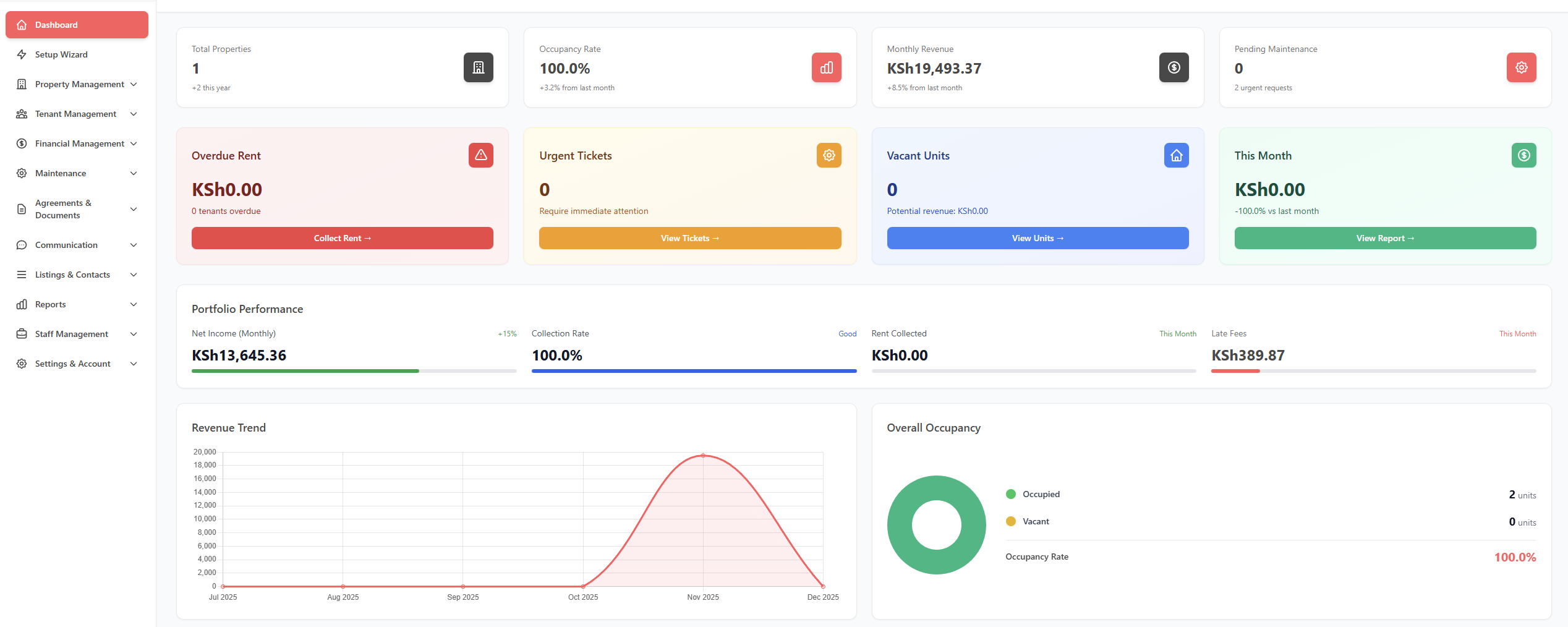
Managing rental income tax shouldn't require a full-time accountant. Here's how PropFlow simplifies the process:
Automatic Income Tracking
Every M-Pesa payment is recorded, categorized, and timestamped. No more digging through SMS messages to calculate your monthly rental income.
One-Click Tax Reports
Generate monthly and annual rental income summaries formatted for iTax filing. Export to PDF or Excel and hand directly to your accountant.
Expense Tracking
Record property expenses against specific properties. At tax time, your deductible expenses are organized and ready, with receipt references attached.
Payment History Audit Trail
If KRA ever asks questions, you have a complete digital record of every payment, every tenant, every receipt. PropFlow gives you confidence during audits.
Multi-Property Consolidation
Own properties in Westlands, South B, and Rongai? PropFlow consolidates all rental income across properties into one tax-ready report.
Planning Ahead: Tax-Smart Strategies for Kenyan Landlords
Strategy 1: Time Your Maintenance Expenses
If you're on standard tax (not MRI), schedule major repairs in months with high rental income to maximize deductions.
Strategy 2: Keep Personal and Rental Accounts Separate
Open a dedicated M-Pesa Paybill or bank account for rental income. This makes tracking and reporting dramatically easier, and looks cleaner if KRA audits.
Strategy 3: Consider a Tax Consultant
For landlords earning over KES 5,000,000 annually, a tax consultant (KES 20,000-50,000 per year) often saves more than they cost through proper deduction planning.
Strategy 4: Use Digital Records
KRA accepts digital records. PropFlow's automated receipt and reporting system means you always have organized, verifiable records ready.
Conclusion: Stay Compliant, Keep More of Your Income
Rental income tax in Kenya doesn't have to be complicated. For most landlords, the MRI simplified tax at 7.5% is straightforward:
- Calculate 7.5% of your monthly gross rental income
- File on iTax by the 20th of the following month
- Pay via M-Pesa to Paybill 572572
- Keep records of all income and expenses
The landlords who get into trouble are the ones who ignore their obligations or keep messy records.
Don't be that landlord.
PropFlow automatically tracks every shilling of rental income, generates tax-ready reports, and keeps your records organized for KRA compliance. Start your free trial today and make this the year you get your rental taxes right.
About PropFlow
PropFlow is a property management platform built specifically for Kenyan landlords. We combine M-Pesa integration with comprehensive property management tools to make landlording easier.
Built by Kenyans, for Kenyan property owners.
Get Started: propflow.ke WhatsApp: 0701 822 032 Email: hello@propflow.ke
Related Articles:
- M-Pesa Rent Collection: The Complete Guide for Kenyan Landlords
- How to Screen Tenants in Kenya: A Landlord's Complete Guide
- Digital Rent Receipts in Kenya: Why Every Landlord Needs Them
Share this guide: Help fellow landlords stay KRA compliant and avoid costly penalties.
Get Free Landlord Tips in Your Inbox
Join 500+ Kenyan property owners. Get M-Pesa collection tips, tenant management guides, and PropFlow updates every 2 weeks.
No spam. Unsubscribe anytime. We respect your inbox.
Related Articles
Keep reading

Best Property Management Software in Kenya for Landlords in 2026
A detailed 2026 guide to choosing property management software in Kenya, covering M-Pesa rent collection, tenant records, maintenance, reports, KRA-ready records, and PropFlow.

Property Maintenance and Repairs in Kenya: 2026 Landlord Checklist
A practical 2026 checklist for Kenyan landlords to manage property maintenance and repairs, tenant requests, work orders, repair costs, updates, and unit history.

How Much Kenyan Landlords Actually Lose to Late Rent (and 5 Ways to Fix It)
The real KES cost of late rent in Kenya, with a 12-unit Nairobi example and 5 fixes that drop late-payment rates from 20% to under 4%.